Showing posts with label Java. Show all posts

Thursday, October 21, 2010

Taman Sari Water Castle, Yogyakarta


Taman Sari Water Palace is a palace site that is actually comprised of several buildings (not all buildings are located in water) and its location is still in the Yogyakarta Palace. In English, better known by the name "Perfume Garden" or "Fragrant Garden", because many fragrant flowers planted this garden environment. Taman Sari - Yogyakarta is not just a recreational park royal family in those days, but it has various functions such as Camouflage area against its enemies, and is a bastion system, while also as a place of meditation for the Kings, where making batik conducted by the concubines of King and the daughters of King, a military training ground for the royal army and there's more.


Taman Sari, Yogyakarta was founded in 1758 that the idea was originally from Prince Mangkubumi (later titled Hamengku Buwono I) and Raden Ronggo Prawirosentiko (Major of Madiun) as an architect, while Demang Tegis (Portuguese who earned his degree from the kingdom) as a structural expert .

Monday, October 18, 2010

Yogyakarta Palace, Yogyakarta

Yogyakarta Palace was built in 1756 AD or the year 1682 in Javanese calendar by Prince Mangkubumi Sukowati who then called as Sri Sultan Hamengku Buwono I. After going through a long struggle between 1747-1755 which ended with the Gianti Agreement.


Before occupying Kraton current,
Sri Sultan Hamengku Buwono I or "Sri Sultan Hemengku Buwono Senopati Ingalogo Ngabdulrahman Sayidin Panotogomo Kalifatullah" lived in Amber Ketawang Gamping, Sleman. Five kilometers west of Yogyakarta Palace.

From Amber Ketawang, His Excellency determine the capital of Mataram Kingdom in the Village Pacetokan. A region that is flanked by two rivers streams, Winongo
and Code. This location is in an imaginary line of the South Seas, Krapyak, Yogyakarta Palace, and Mount Merapi.

Friday, October 15, 2010

Prambanan Temple, Yogyakarta

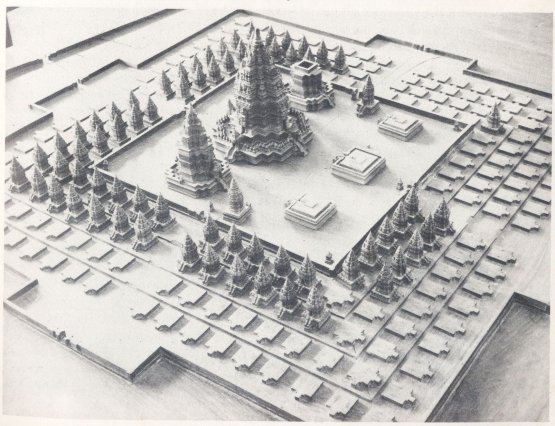
Prambanan is a stunningly beautiful building which is built in the 10th century during the reign of two kings, Rakai Pikatan and Rakai Balitung. Rose as high as 47 meters (5 meters higher than Borobudur Temple), the foundation of this temple has fulfilled the desire to show Hindu triumph in the land of Java. This temple is located 17 kilometers from the city center, in the middle of an area that now functions as beautiful park.


There is a legend that Javanese people always tell about this temple. Once, a man named Bandung Bondowoso loved Roro Jonggrang. Because of his love, Jonggrang asked Bondowoso make 1000 temples with statues in one night. The request was nearly fulfilled, when Jonggrang asked the villagers to pound rice and make a big fire that created an atmosphere like the morning. Bondowoso who only completed 999 statues cursed Jonggrang be a statue of the 1000 because he felt cheated.

Thursday, October 14, 2010

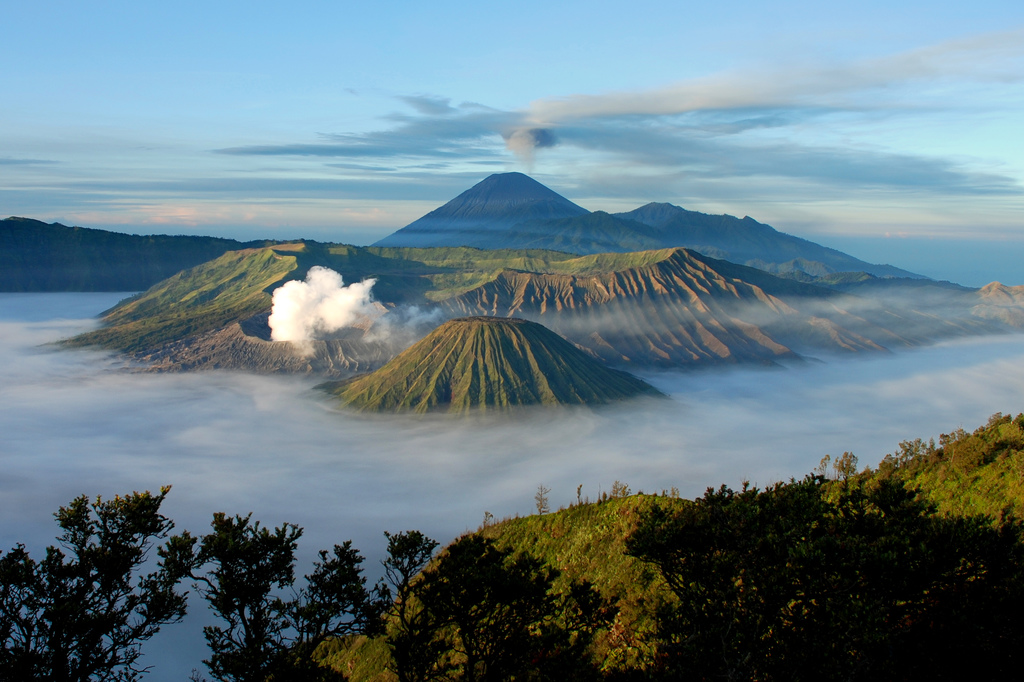
Mount Bromo, East Java

Mount Bromo (from Sanskrit / Old Javanese: "Brahma", one of the main Hindu gods), this volcano is still active and most famous as a tourist attraction in East Java. As a tourist attraction, Mount Bromo become attractive because of its status as the volcano is still active.


Bromo height is 2392 meters above sea level and it is located in four regions, namely Probolinggo, Pasuruan, Lumajang, and Malang. Mount Bromo stretch between valleys and canyons with the caldera or the sea of sand covering some 10 square kilometers.

Sunday, October 10, 2010

Batik

Batik is a cloth that traditionally uses a manual wax-resist dyeing technique. Although the word's origin is Javanese, its etymology may be either from the Javanese "amba" ("to write") and "titik" ("dot" or "point"), or constructed from a hypothetical Proto-Austronesian root *beCík", meaning "to tattoo" from the use of a needle in the process. The word is first recorded in English in the Encyclopædia Britannica of 1880, in which it is spelled battik. It is attested in the Indonesian Archipelago during the Dutch colonial period in various forms: "mbatek", "mbatik", "batek" and "batik".


Javanese traditional batik, especially from Yogyakarta and Surakarta, has special meanings rooted to the Javanese conceptualization of the universe. Traditional colours include indigo, dark brown, and white, which represent the three major Hindu Gods (Brahmā, Visnu, and Śiva). This is related to the fact that natural dyes are most commonly available in indigo and brown. Certain patterns can only be worn by nobility; traditionally, wider stripes or wavy lines of greater width indicated higher rank. Consequently, during Javanese ceremonies, one could determine the royal lineage of a person by the cloth he or she was wearing.

Saturday, October 9, 2010

Malioboro, Yogyakarta

Stretching on imaginary poles connecting Yogyakarta Sultan Palace, Tugu and the peak of Merapi Mountain, this street forms trading locality after Sri Sultan Hamengku Buwono I developed means of trading through traditional market since 1758. After 248 years, the place still persists as a trading area; it even becomes the icon of Yogyakarta, known as Malioboro.


Located around 800 meters from Yogyakarta Sultan Palace, this place was always crowded with flowers each time the Palace held ceremonies. Malioboro that in Sanskrit means bouquet serves as a basis for naming this street.

Framed by shops, offices, restaurants, star hotels and historical buildings, the street that once functioned as struggling center during the second Dutch military aggression in 1948 was once a place of wandering for the artists joining together in Persada Studi Klub (PSK) community led by Umbul Landu Paranggi since 1970s to around the end of 1990s.

Friday, October 8, 2010

Mount Merapi, Yogyakarta

Mount Merapi (2914 m) are still regarded as an active volcano and the most dangerous in Indonesia, but it offers a panoramic and beautiful natural attractions and amazing. Geographically located in the border district of Sleman (Yogyakarta), Regency Magelang (Central Java), Boyolali district (Central Java) and Klaten (Central Java). Drive 30 km to the north of Yogyakarta, 27 km to the east of the city of Magelang, 20 km west from the city of Boyolali and 25 km to the north of the city of Klaten.


According to Atlas Van Nederland Tropische sheet 21 (1938) lies in the geographical position of 7 degrees 32.5 ' South latitude and 110 degrees 26.5' East Longitude. With a height of 2914 m above sea level. Being at the crossroads of the border transverse fault Yogyakarta Special Province and Central Java and Java cross Longitudinal fault (see Lucas Triyoga Saso, 1990, Java & Mount Merapi Human Perception and Systems faith, Gadjahmada Univ. Press). Erupted over 37 times, the largest in 1972 that killed 3000 people. Kliwon last erupted on Tuesday 22 November 1994, with a death toll of more than 50 people

Thursday, October 7, 2010

Borobudur Temple, Central Java

Who does not know Borobudur? This Buddhist temple has 1460 relief panels and 504 Buddha effigies in its complex. Millions of people are eager to visit this building as one of the World Wonder Heritages. It is not surprising since architecturally and functionally, as the place for Buddhists to say their prayer, Borobudur is attractive.


Borobudur was built by King Samaratungga, one of the kings of Old Mataram Kingdom, the descendant of Sailendra dynasty. Based on Kayumwungan inscription, an Indonesian named Hudaya Kandahjaya revealed that Borobudur was a place for praying that was completed to be built on 26 May 824, almost one hundred years from the time the construction was begun. The name of Borobudur, as some people say, means a mountain having terraces (budhara), while other says that Borobudur means monastery on the high place.

Tuesday, October 5, 2010

Parangtritis Beach, Yogyakarta

Parangtritis is one beach that must be visited, not just because it is the most popular beach in Yogyakarta, but also has close linkages with various other attractions, such as the sultan's palace, Beach Parangkusumo and Merapi region. The beach is located 27 kilometers from the city center is also part of the power of "Nyi Roro Kidul", the Queen of South Sea.


Parangtritis has its own history. Perhaps, someone named Dipokusumo that an escape from the kingdom of Majapahit came to this area hundreds of years ago to do meditation. When he saw droplets of water that flows from the crack rock, he named this area parangtritis, from the word "parang" (stone) and "tumaritis" (water drops). The beach is located in the area that was eventually named similar.